
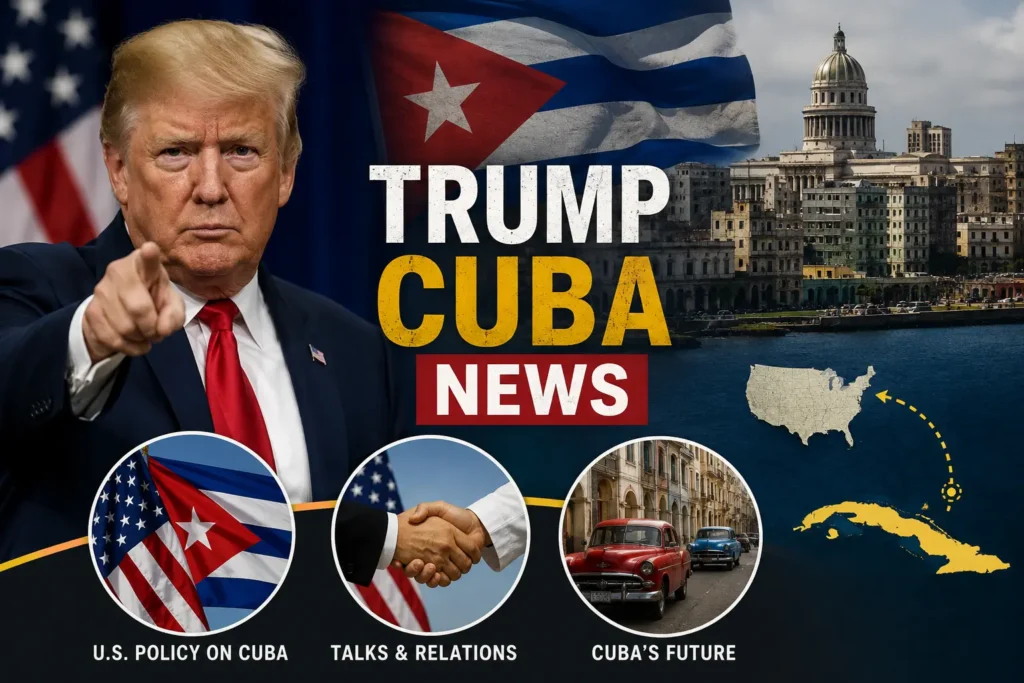
Trump Cuba news has become a major international story in 2026 as the United States increases pressure on Havana. President Donald Trump’s administration has expanded sanctions, targeted Cuban officials and businesses, and taken steps aimed at limiting the island’s access to oil. The policy has also raised questions about possible military action and the future
Trump Cuba news has become a major international story in 2026 as the United States increases pressure on Havana. President Donald Trump’s administration has expanded sanctions, targeted Cuban officials and businesses, and taken steps aimed at limiting the island’s access to oil. The policy has also raised questions about possible military action and the future of U.S.-Cuba relations. Secretary of State Marco Rubio has played a leading role in the administration’s Cuba strategy. At the same time, Cuba is experiencing severe blackouts, shortages, and economic stress. The latest developments therefore involve foreign policy, energy, humanitarian concerns, and the possibility of major political change.
Who Is Trump? A brief biography
| Biography Detail | Information |
|---|---|
| Full Name | Donald John Trump |
| Known As | Donald Trump |
| Date of Birth | June 14, 1946 |
| Birthplace | Queens, New York City, United States |
| Nationality | American |
| Profession | Politician, businessman, author, and television personality |
| Political Party | Republican Party |
| Current Position | 47th President of the United States |
| First Presidency | 45th President of the United States, 2017–2021 |
| Second Presidency | 47th President of the United States, beginning January 20, 2025 |
| Previous Political Experience | President of the United States |
| Education | University of Pennsylvania, Wharton School |
| Field of Study | Economics |
| Business Background | Real estate development and business |
| Notable Book | The Art of the Deal |
| Children | Five: Donald Jr., Ivanka, Eric, Tiffany, and Barron |
| Grandchildren | 11 |
| Spouse | Melania Trump |
| Father | Fred Trump |
| Mother | Mary Anne MacLeod Trump |
| Presidential Status | 45th and 47th President of the United States |
| 2024 Election | Won the 2024 U.S. presidential election and returned to the White House |
| Political Movement | Associated with the “Make America Great Again” (MAGA) movement |
| Business Recognition | Built a prominent career in real estate, particularly in New York City |
| Author | The White House states that he has written more than 14 bestsellers. |
| Notable Achievement | Became the first U.S. president to serve non-consecutive terms since Grover Cleveland. |
Trump Cuba News: What Is Happening Now?
The latest Trump Cuba news centers on continued economic and political pressure against the Cuban government. On August 6, 2026, the U.S. Treasury announced new Cuba-related sanctions targeting six Cuban individuals and five entities. Two previously sanctioned Cubans also received additional designations. These actions show that Washington is continuing to use financial restrictions rather than easing its pressure on Havana. The measures are part of a much broader policy that has developed throughout 2026. For readers following the story, the important point is that U.S. policy has not moved toward normalization. Instead, the Trump administration is continuing to increase pressure on Cuban government-linked people and organizations.
The administration’s broader strategy includes sanctions, restrictions on Cuba’s access to energy, and pressure on countries that support Havana. In January, Trump declared a national emergency involving the Cuban government and established a process for imposing additional tariffs on countries that provide oil to Cuba. In May, he signed another executive order expanding sanctions against people and organizations connected to repression, corruption, or the Cuban security system. These decisions represent a significant escalation from ordinary diplomatic criticism. They also affect businesses and foreign governments that maintain economic relationships with Cuba. As a result, Trump Cuba news is increasingly connected to international trade, energy markets, and regional diplomacy. Read More : Konerak Sinthasomphone: Life, Family and Tragedy
Trump Cuba Policy Under Marco Rubio
Secretary of State Marco Rubio has become one of the most important figures in the administration’s Cuba policy. Rubio has argued that Cuba’s economic and political system is deeply dysfunctional and that major changes are necessary. He has also described Cuba as a national security concern because of its relationships with countries that oppose Washington. In recent months, Rubio has supported maintaining strong pressure rather than quickly returning to traditional diplomatic engagement. His position is important because he is closely involved in shaping the administration’s foreign policy. The latest strategy therefore reflects both Trump’s broader approach and Rubio’s long-standing interest in Cuban affairs.
Recent reporting indicates that Rubio is directing an extensive pressure campaign designed to reduce what the administration sees as Havana’s economic escape routes. Axios reported on August 7 that the campaign includes more than two dozen punitive actions, affecting Cuban and foreign entities. The report also said the administration expects further pressure rather than an immediate relaxation of sanctions. At the same time, diplomatic contacts have not completely disappeared. Trump said earlier in 2026 that Cuban officials were talking with Rubio and that Washington would soon take action. This combination of pressure and communication makes the current U.S.-Cuba relationship more complicated than a simple break in diplomatic contact.
Why Is the United States Targeting Cuba?
The Trump administration says its Cuba policy is based on national security, human rights, political repression, and opposition to the Cuban government’s relationships with U.S. adversaries. The White House has argued that Havana poses an unusual and extraordinary threat to U.S. national security and foreign policy. Its May 2026 executive order specifically expanded sanctions against officials and entities associated with repression and the Cuban security apparatus. Washington also says it wants to support the Cuban people and encourage the development of a private sector independent of government control. These are the official reasons given for the administration’s tougher policy toward Havana.
The administration’s critics offer a different interpretation. They argue that stronger sanctions can worsen living conditions for ordinary Cubans without necessarily forcing political change. United Nations human rights experts recently warned that the humanitarian situation could become extremely serious and urged governments to protect access to essential goods. The debate is therefore not only about whether Cuba’s government should change. It is also about how pressure affects people who have limited control over government decisions. Understanding both sides is important when reading Trump Cuba news, because official statements and humanitarian assessments can emphasize very different consequences of the same policy.
Trump Cuba News and the Oil Restrictions
Oil has become central to the latest U.S.-Cuba dispute. In January 2026, Trump signed an executive order declaring a national emergency and creating a mechanism for imposing tariffs on countries that provide oil to Cuba. The White House said the policy was intended to address threats it associates with the Cuban government. The administration has argued that Cuba has relied heavily on outside energy support and that limiting this support can increase pressure on Havana. Energy restrictions are particularly significant because Cuba depends on imported fuel for electricity generation, transportation, agriculture, and other essential economic activity. This makes oil policy directly relevant to everyday life across the island.
The effects have become visible in Cuba’s electricity system. The Associated Press reported on August 7 that Cubans were dealing with severe, days-long blackouts and short, unpredictable periods of electricity. Another AP report said Cuba had experienced multiple nationwide grid failures in 2026, with rolling outages sometimes lasting more than 20 hours per day. U.S. restrictions are one factor identified in the worsening energy situation, while Cuba’s aging infrastructure and domestic economic problems are also important. This distinction matters. It would be inaccurate to attribute every problem to one policy alone. The current crisis reflects pressure from abroad combined with serious internal weaknesses.
 How Are Cubans Being Affected?
The growing pressure has consequences beyond government offices and financial institutions. Cuba’s electricity shortages have affected homes, businesses, transportation, tourism, hospitals, and food storage. AP reports that families have adjusted their daily routines around short periods when power becomes available. Some people have used generators, solar equipment, rechargeable devices, and other alternatives to manage the outages. Long blackouts also create problems for refrigeration, communication, work, and education. These conditions make the Cuba story a humanitarian issue as well as a foreign-policy dispute. For ordinary families, international sanctions and domestic economic weaknesses can combine to create practical problems that are much more immediate than political arguments.
Food and medicine shortages are another concern. Axios reported that Cuba has faced widespread shortages while relying heavily on U.S.-sourced goods for some essential needs. The same report said foreign businesses have been pulling back because of concerns about U.S. retaliation. At the same time, American companies have increased their involvement in certain parts of the Cuban market, particularly energy-related areas. These developments create an unusual economic environment. The United States is simultaneously applying pressure and remaining an important potential source of goods. This is why the latest Trump Cuba news should be followed carefully rather than summarized simply as a total economic cutoff.
Could Trump Take Military Action Against Cuba?
Military action is one of the most serious questions surrounding the current U.S.-Cuba relationship. In May 2026, Trump publicly raised the possibility of U.S. intervention in Cuba. He said previous presidents had considered military action for decades and suggested that he might ultimately be the president who takes such a step. Rubio also described Cuba as a national security concern and said the existing situation was unacceptable. These statements increased concern about a possible escalation. However, public discussion of military action does not mean that an invasion or attack has been ordered. It is important to distinguish threats, planning discussions, and actual military decisions.
Recent reporting has continued to raise questions about military planning. However, available reports do not establish that Trump has ordered a military operation against Cuba. Earlier reports about possible Pentagon planning emphasized that examining military options does not automatically mean an operation has been approved. This distinction is especially important because speculation can spread quickly during geopolitical crises. For now, the clearest confirmed policy remains economic and diplomatic pressure, including sanctions and energy restrictions. Military intervention remains a serious possibility discussed publicly by officials, but it should not be presented as an announced or inevitable event. Readers should watch official statements for evidence of any actual change.
Trump Cuba News and Diplomatic Talks
Despite the aggressive policy, communication between Washington and Havana has not completely disappeared. In March 2026, Trump said Cuba was speaking with Rubio and that the United States would do something concerning Cuba soon. Rubio said Havana’s political and economic system needed dramatic change. These comments suggested that communication existed even while Washington was increasing pressure. Diplomacy can sometimes continue during periods of confrontation because governments need channels for negotiation, humanitarian issues, migration, and security concerns. Therefore, readers should not assume that sanctions automatically mean all communication has ended. The current relationship includes both confrontation and limited diplomatic engagement at the same time.
There are also questions about what a future agreement could look like. Earlier reports suggested that possible discussions involved energy, tourism, ports, and political transition. However, details of any potential deal remain uncertain, and the administration has not announced a comprehensive settlement with Havana. Trump has also continued to speak in forceful terms about Cuba. This creates an unusual situation where pressure may be intended to produce negotiations rather than replace them entirely. The key issue is whether Havana would accept major political or economic changes in exchange for reduced U.S. pressure. So far, no final agreement has resolved that question.
What Does Trump Want From Cuba?
The Trump administration has repeatedly said it wants significant changes inside Cuba. The White House has emphasized human rights, political accountability, national security, and the growth of a private sector that is not controlled by the Cuban government. Its 2025 Cuba policy memorandum also sought to prevent economic activity from disproportionately benefiting Cuban military and security organizations. The administration argues that these measures can weaken institutions it considers responsible for repression. In practical terms, Washington wants Havana to make meaningful political and economic changes before U.S. pressure is reduced. This approach is much tougher than policies that prioritize gradual engagement and normalization.
The Cuban government and its supporters have rejected the idea that Washington should determine Cuba’s political future. Critics of the U.S. strategy also argue that sanctions can increase hardship without guaranteeing democratic reform. This disagreement is at the heart of the current dispute. One side views economic pressure as a tool for forcing change, while the other warns that ordinary people may pay the highest price. For anyone following Trump Cuba news, this is an important distinction. The debate is not simply about whether change is needed. It is about who should decide that change, how quickly it should happen, and what costs are acceptable during the process.
What Happens Next for U.S.-Cuba Relations?
The next stage of U.S.-Cuba relations will likely depend on whether Washington believes its pressure campaign is producing meaningful results. The Trump administration has shown little sign of quickly easing sanctions. New measures announced in August indicate that pressure remains active. At the same time, worsening conditions in Cuba could create incentives for diplomatic discussions over energy, humanitarian aid, migration, or economic reform. This makes the coming months important for both governments. Readers should watch for new sanctions, official negotiations, changes in oil supplies, and statements from Trump or Rubio. Those developments will provide clearer evidence about the direction of the policy.
The humanitarian situation could also influence future decisions. International organizations and human rights experts are warning about the effects of prolonged shortages and power failures. The United States says it is willing to provide humanitarian assistance under certain conditions, while Cuban authorities have their own concerns about sovereignty and outside involvement. This creates another possible area for negotiation. If both sides can establish reliable channels for humanitarian aid, it could reduce some immediate suffering without resolving the larger political dispute. Readers following our U.S. foreign policy coverage and Cuba economy updates can use those broader topics to understand how this relationship fits into wider regional developments.
Why Trump Cuba News Matters Globally
The Cuba dispute matters beyond the island because it involves the United States, Latin America, international trade, energy supplies, and regional security. Cuba is located only about 90 miles from Florida, making developments there especially sensitive for Washington. The island also maintains relationships with countries that the Trump administration considers strategic competitors or adversaries. As a result, U.S. officials view Cuba through both an economic and national-security lens. Any major change could affect migration, investment, tourism, energy markets, and diplomatic relationships across the Caribbean. That is why Trump Cuba news has become an important subject for international observers, not only Cuban Americans or U.S. policymakers.
The story also demonstrates how foreign policy decisions can affect ordinary people. A sanction announced in Washington can influence a company’s ability to operate in Cuba. Restrictions on fuel can affect electricity generation and transportation. Political tensions can then influence tourism, employment, food supplies, and migration. These connections make the current situation difficult to understand through political headlines alone. A complete picture requires looking at government policy, economic conditions, humanitarian effects, and diplomatic developments together. As new information emerges, readers should rely on verified reporting and official documents rather than social-media rumors. The situation remains fluid, and important developments can change quickly.
Frequently Asked Questions About Trump Cuba News
What is the latest Trump Cuba news?
The latest major development is a new round of U.S. sanctions announced on August 6, 2026. The Treasury Department targeted six Cuban individuals and five entities, while adding further designations against two already-sanctioned Cubans. The move shows that the Trump administration continues to increase economic pressure on Havana.
Is Trump planning to invade Cuba?
Trump has publicly raised the possibility of U.S. military action against Cuba, but there is no confirmed announcement of an invasion. Reports about military planning should not be treated as proof that an operation has been approved. Current confirmed policy continues to focus heavily on sanctions, economic pressure, and diplomacy.
Why is Trump restricting oil going to Cuba?
The Trump administration says Cuba presents national-security and foreign-policy concerns. A January 2026 executive order created a process for imposing tariffs on countries that provide oil to Cuba. Washington argues that reducing outside support can pressure Havana to make major political and economic changes.
How are U.S. policies affecting Cuba?
Cuba is experiencing severe electricity shortages, blackouts, transportation problems, and shortages of food and medicine. U.S. energy restrictions are one factor contributing to the crisis, while Cuba’s aging infrastructure and domestic economic problems also play major roles. The effects are particularly serious for ordinary households.
Is the United States still talking with Cuba?
Yes. Despite increasing pressure, communication has continued. Trump said in March that Cuban officials were speaking with Secretary of State Marco Rubio. However, the administration has demanded major changes and has continued imposing sanctions. Therefore, diplomacy exists alongside a strong pressure campaign rather than replacing it.
Conclusion
The latest Trump Cuba news shows a U.S.-Cuba relationship under intense pressure. The Trump administration has expanded sanctions, restricted Cuba’s access to energy, and continued demanding major political and economic changes. At the same time, Cuba is facing severe blackouts, shortages, and economic difficulties that are affecting daily life. Trump has also raised the possibility of military action, although no invasion has been officially announced. Diplomatic communication remains possible, creating an uncertain mix of confrontation and negotiation. The coming months will be important as Washington decides whether to increase pressure further or pursue a broader agreement. For continued context, follow our latest Cuba political news and international affairs coverage.


















Leave a Comment
Your email address will not be published. Required fields are marked with *